
Suwannee County Court Records After a Jail Arrest
The path runs in a clear order. A person is arrested, booked at the Suwannee County Jail, and then the case moves toward court. The State Attorney for the Third Judicial Circuit decides what charges to file, and that filing opens a case that becomes the court record. So an arrest is the start, and the court record is what follows once the prosecutor acts. The jail roster and the court file are two different things created by two different offices.
Keep the two sides clear. The booking and custody side lives on the jail inmate records page, and booking photos live on the jail roster mugshots page. The court record is the set of charges, filings, and case events the clerk holds after an arrest. The Suwannee County Clerk of Court is direct about this split, routing arrest, jail, and mugshot questions to the sheriff while keeping court case files as clerk records.
How to Find Suwannee County Court Records After an Arrest
There is no public online case-search portal for Suwannee criminal cases. The clerk states plainly that court records are not online, so the realistic route is the clerk's office. Start by noting the booking details from the jail roster, then contact the clerk for the case file, calendar, or a certified disposition.
- Record the charge, statute, agency, and any court case number shown on the jail roster.
- Call the Suwannee Clerk of Court at (386) 362-0500 and ask for the criminal division.
- Ask how to request the case file, the docket or calendar, copies, or a certified disposition.
- For a written request, use the official public-records portal or mail a request to the clerk.
The clerk's criminal-court page is where this notice appears, and it is the right starting reference for the process.
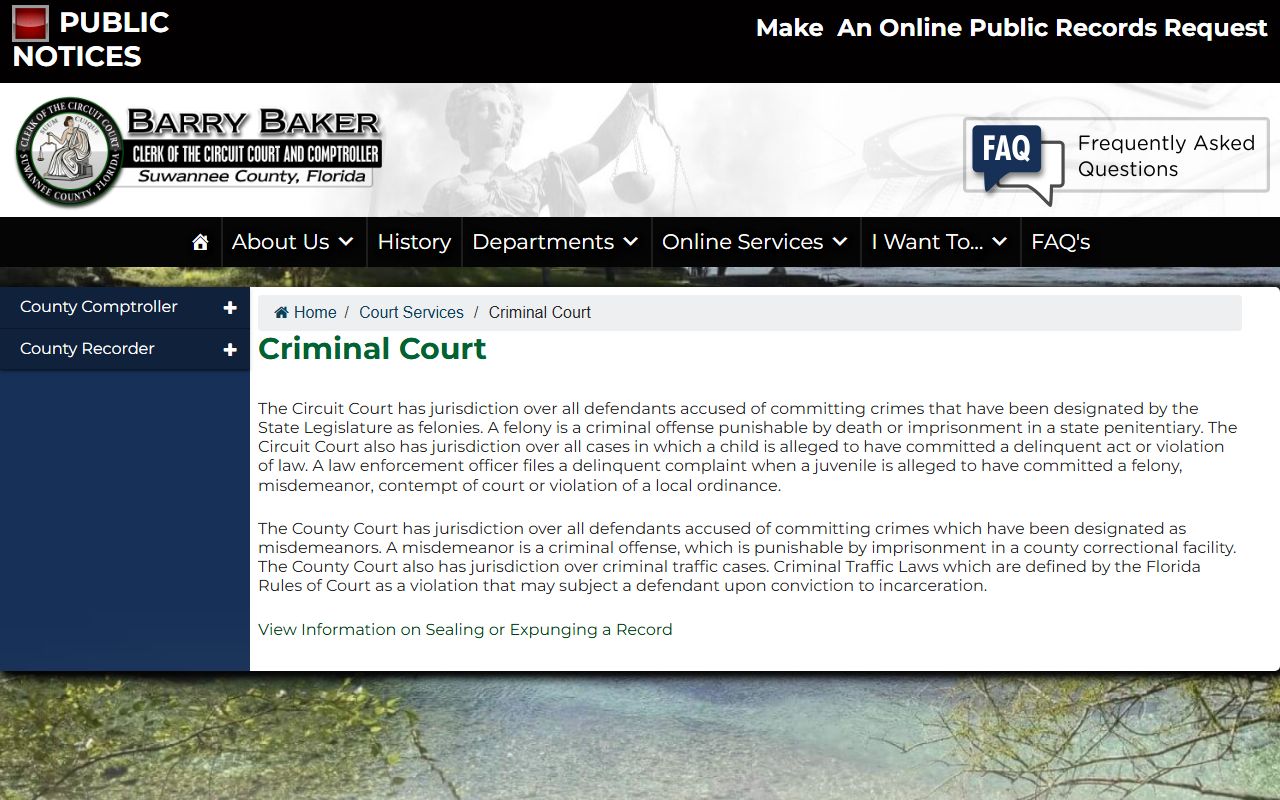
Because that clerk criminal-court page confirms records are not online, plan to call or file a request rather than expecting a search box. For a statewide criminal history rather than a single case, the Florida Department of Law Enforcement is the central repository, with a public record check fee of $24.
How Charges Get Filed After an Arrest
The charge record begins when a prosecutor files a charging document. Booking happens first at the jail, then the State Attorney reviews the arrest and files the formal charge. There are three main documents, and the one used depends on the level of the offense and whether a grand jury is involved.
| Complaint | Information | Indictment | |
|---|---|---|---|
| Filed By | Officer / Prosecutor | State Attorney | Grand Jury |
| Common For | Misdemeanors | Many felonies | Most serious felonies |
| Starts | The case | The case | The case |
Suwannee County sits in Florida's Third Judicial Circuit. County Court handles misdemeanors and criminal traffic, while Circuit Court handles felonies and juvenile delinquency. The clerk keeps the filings for both, but does not publish them online.
The pathway reads as a short flow: arrest and booking at the jail, then first appearance before a county judge, then the prosecutor's charge decision, then arraignment for a felony, and finally the court file the clerk maintains. Each stage is handled by a different office. The sheriff books, the judge sets bond, the State Attorney charges, and the clerk holds the record. Knowing which office owns which step is what makes a court-records request after an arrest go quickly.
Statewide Criminal History After an Arrest
A single county case is different from a full criminal history. For a statewide record, the Florida Department of Law Enforcement is the central repository, and it offers both instant and certified checks. The agency lists a public record check fee of $24. That history covers Florida arrests and dispositions across counties, which a single Suwannee court file does not.
For a Suwannee case specifically, a certified disposition may be needed, for a sealing petition or for proof of an outcome. The clerk packet notes that certified dispositions can be purchased in person, by phone at (386) 362-0500, or by mail. So the statewide history and the local certified disposition serve two different needs, and a complete picture after an arrest can require both.
Charge Status After an Arrest and What It Means
Charges shift as a case moves. A booking charge can be amended, reduced, added to, or dropped once the prosecutor reviews the arrest. That is why the charge on the jail roster may not match the charge the state finally files. The roster charge can even name the arresting or originating agency in the case-number field, but it is not the final court docket.
| Status | What It Means |
|---|---|
| Pending | The charge is filed and the case is open, with no final outcome yet. |
| Amended / Reduced | The prosecutor changed the charge, often to a different or lower offense. |
| Dismissed | The charge was dropped by the court and is no longer pursued. |
| Nolle Prosequi | The prosecutor chose not to pursue the charge. |
The clerk FAQ is a useful map of who holds what, because it lists in plain terms which records are clerk records and which belong to the sheriff, FDLE, or the state corrections department.
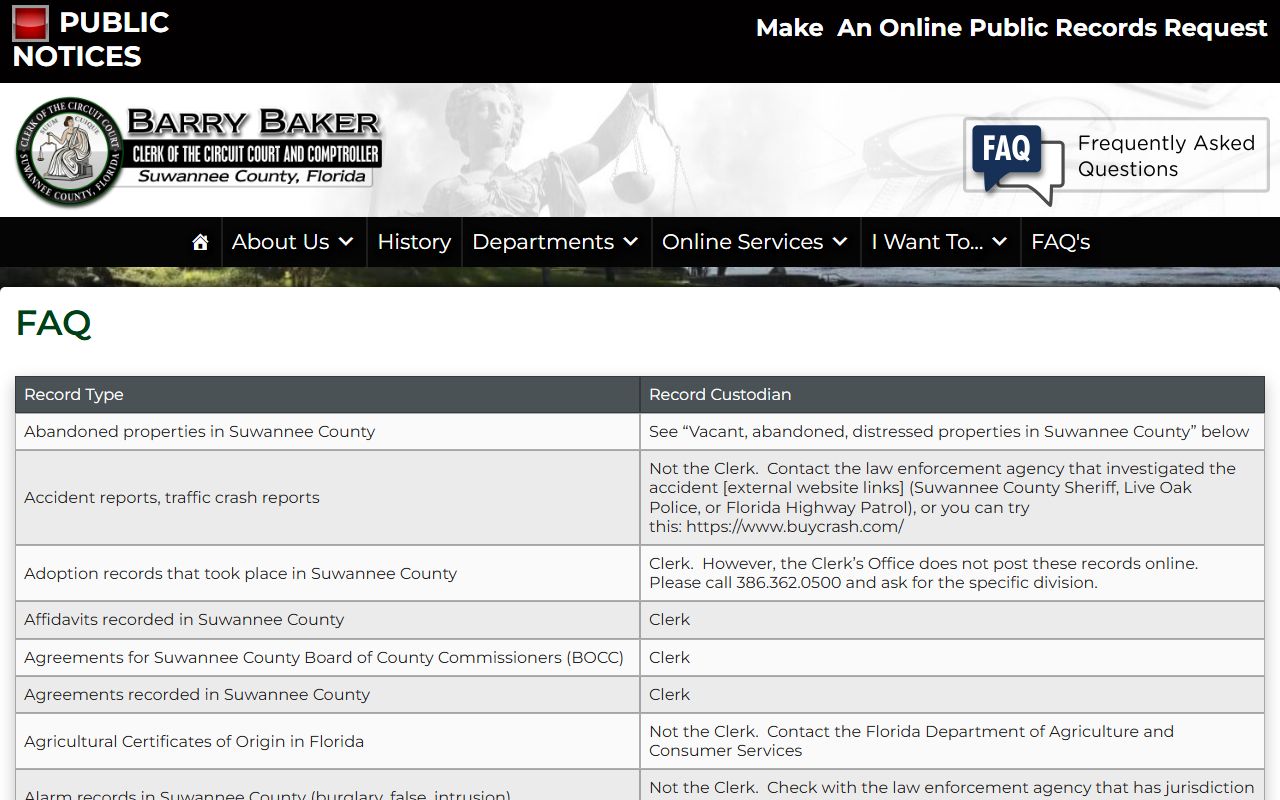
Reading that clerk FAQ first can save a wasted call, since it sends arrest reports, warrants, and inmate questions to the sheriff and keeps only the court case files with the clerk.
Bond and Release After an Arrest
Bond is addressed early. Clerk material indicates that a person who cannot bond out within 24 hours appears before a county judge for first appearance, where bond and Public Defender qualification are reviewed. A hold can keep a person in custody even when a bond amount is shown, which is why a $0.00 roster total does not always mean release. Verify current bond and any hold with the jail booking desk before paying.
| Bond Type | How It Works |
|---|---|
| Cash Bond | Money paid directly to secure release. |
| Surety Bond | Bond posted through a licensed bail agent; Florida allows commercial bonding. |
| Recognizance | Release on court-set conditions rather than full cash, where ordered. |
| No-Bond Hold | The person cannot post a standard bond until court or agency action. |
Warrants That Lead to an Arrest
An outstanding warrant often starts the cycle. The sheriff processes and serves warrants that come from courts and agencies and places notices in local, state, and federal databases as required. The sheriff lists warrant types that include bench warrants and failure to appear, orders of arrest, violations of probation, violations of community control, capias, and orders to revoke bond. No public warrant-name search was located, so a warrant question goes to the sheriff by phone or records request.
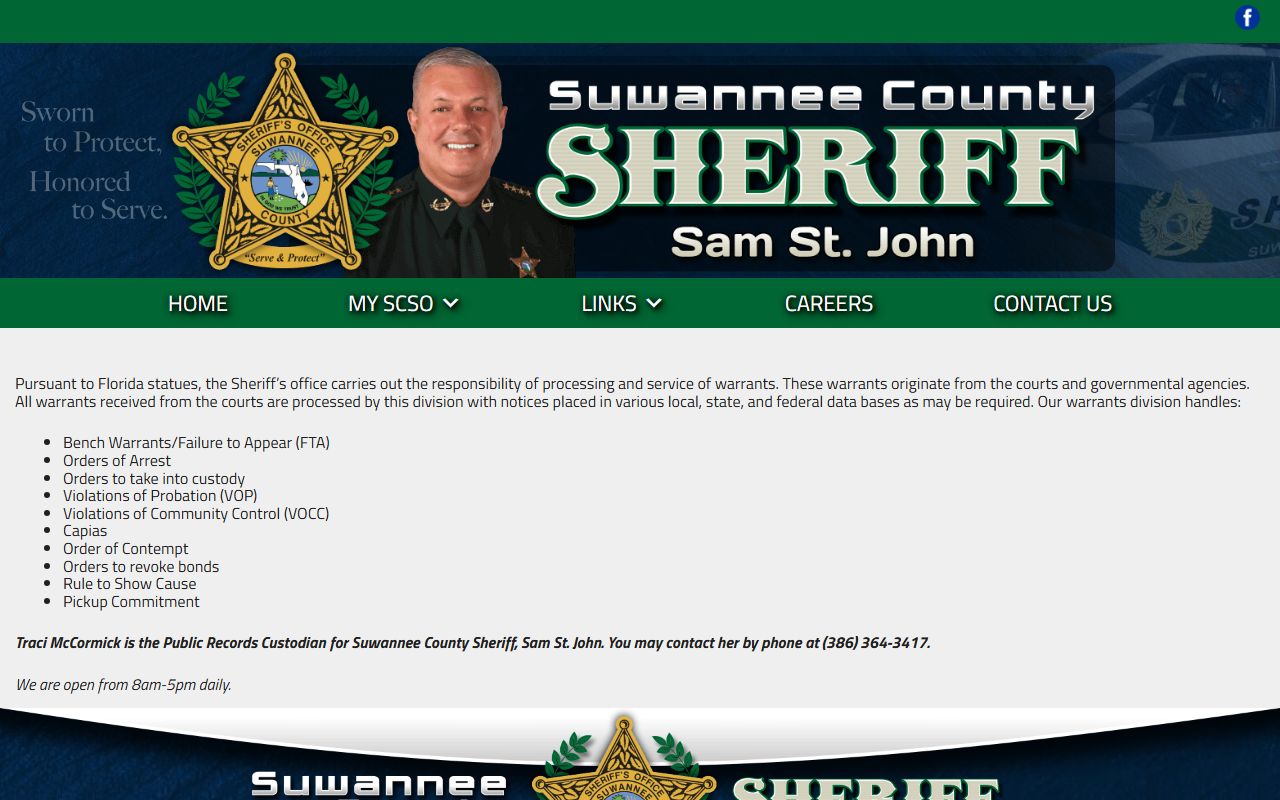
The sheriff warrants page lists the warrant categories and a records contact at (386) 364-3417. When a warrant ties to a missed court date, the clerk handles the case calendar, while the sheriff handles the active warrant itself.
The Third Circuit State Attorney's Role
The prosecutor drives the charge decision. The Office of the State Attorney for the Third Judicial Circuit serves Suwannee and six neighboring counties, and it decides what charges to file, amend, or drop after an arrest. Its Live Oak office and public-records custodian handle prosecution-related requests, separate from the clerk's case files.
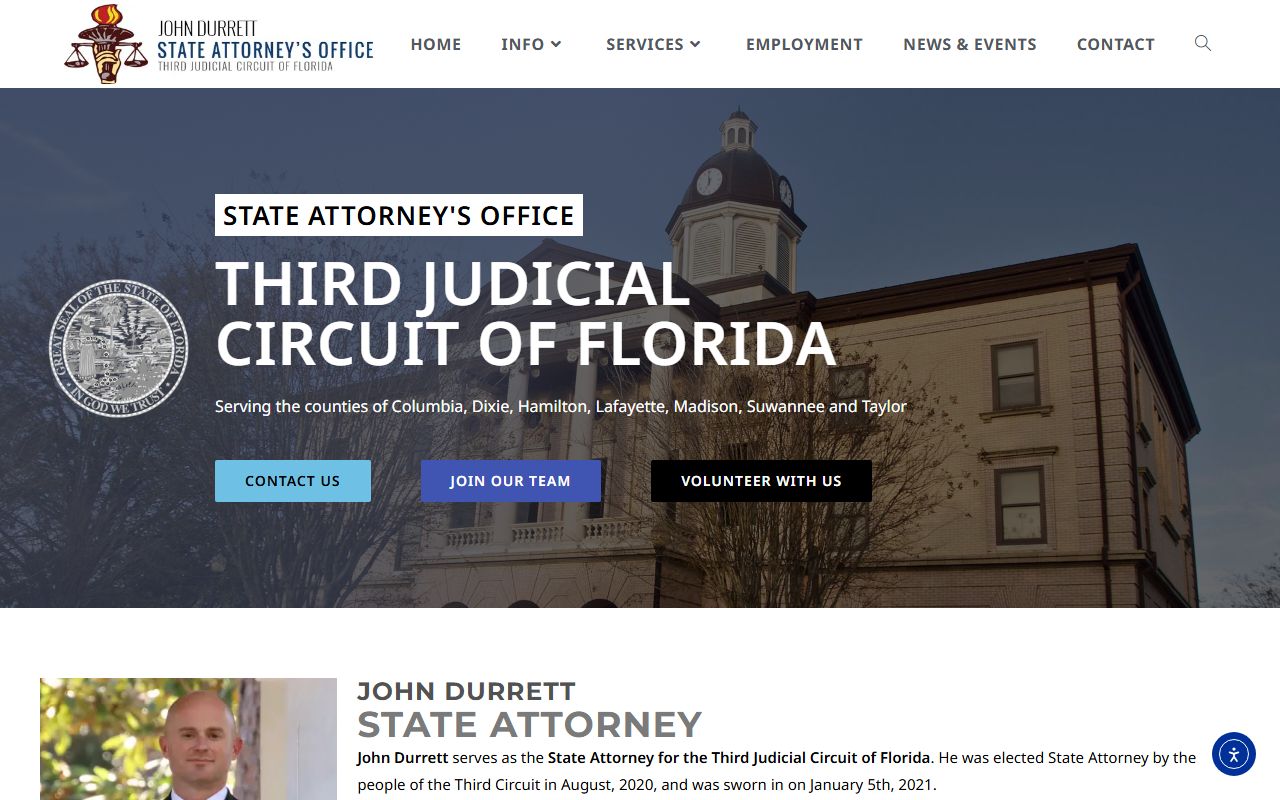
The Third Circuit State Attorney site is the right contact for prosecution records and victim services. The Live Oak office is at 310 SW Pine Avenue, with a phone of (386) 362-2320 and a public-records email for requests.
Charges vs. Convictions
An arrest and a charge are not a conviction. A roster entry or a filed charge is an accusation. A conviction exists only after a plea or verdict and a final disposition. Never read a jail roster as proof that someone was found guilty.
| Charge | Conviction | |
|---|---|---|
| Stage | Accusation | Verdict or plea |
| Burden of Proof | Probable cause | Beyond a reasonable doubt |
| Public Record | Yes | Yes |
Sealed vs. Expunged Arrest Records
Florida lets eligible people seal or expunge a record after a qualifying outcome. The two are not the same. Sealing hides a record from most public view, while expunction goes further and treats the record as destroyed for most purposes. The Suwannee clerk packet says you must first obtain a Certificate of Eligibility from the Florida Department of Law Enforcement, then file the petition, sworn statement, and proposed order with the court.
| Sealed | Expunged | |
|---|---|---|
| Visibility | Hidden from public view | Treated as never existed for most uses |
| Law Enforcement | Limited access | Very limited access |
| First Step | FDLE Certificate of Eligibility | FDLE Certificate of Eligibility |
The governing statutes are Florida Statutes § 943.059 for sealing and § 943.0585 for expunction. Certified dispositions for the filing may be purchased from the clerk in person, by phone, or by mail.
Background Check Considerations
A casual lookup is not a background check. A formal screening for hiring, housing, or credit is governed by the Fair Credit Reporting Act and must run through a compliant consumer reporting agency. Reading a roster or a court file for personal knowledge is different from making an FCRA-covered decision.
Important: This site is not an FCRA-regulated consumer reporting agency, and nothing here may be used to screen for employment, housing, credit, or insurance.
Restricted Court Records After an Arrest in Suwannee County
Some court records after an arrest are limited even when the case is public. Juvenile delinquency matters, sealed or expunged charges, and active criminal investigative information can be withheld or redacted under Florida law. A custodian who withholds a record must point to a statutory exemption, so it is fair to ask which exemption applies if a record is denied. Court files can also carry redacted personal information while the case itself stays open to the public.